Savary Island is a sandbar off the Sunshine Coast near Lund that most BC residents have never heard of. It doesn't have a grocery store or a road that connects to the mainland. You get there by water taxi from Powell River, and you leave the same way. For most of the year it's a quiet place that a small number of people know about and a larger number of people have on a list somewhere.
On a clear June night, with no moon and the Milky Way core rising in the south, it's one of the most extraordinary places in BC to photograph the night sky. The combination of minimal light pollution, a flat sandy beach facing south, and warm enough temperatures to actually be comfortable standing in a field at 1am makes it a specific kind of special that very few places in the province can match.
Why Savary Island Works for Astrophotography
The island has almost no permanent infrastructure. There's no town, no commercial district, no industrial light source within range. The closest significant light pollution is Powell River, which sits at a distance that puts it well below the horizon from the south-facing beaches. The result is a sky that reads dark on a light pollution map and darker still in person.
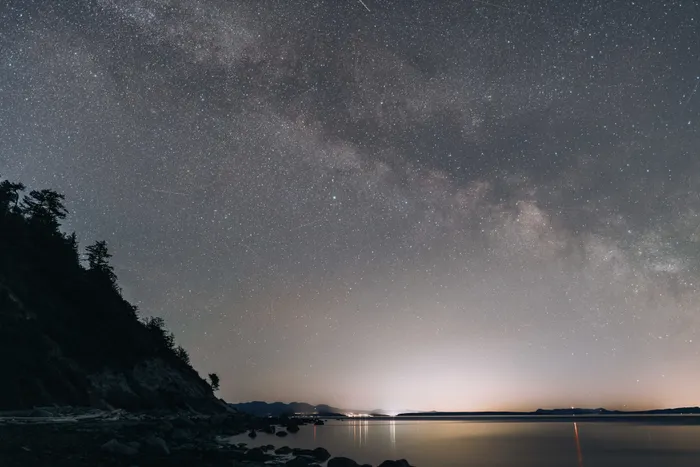
South-facing beaches are important for Milky Way photography at BC's latitude. The galactic core rises in the south and southeast from approximately April through October, and you need an unobstructed southern horizon to capture it well. Savary's main beach faces almost directly south across the Strait of Georgia, with nothing between you and the Oregon coast but open water.
The timing window is narrower than people expect. June through August gives you the core at its highest and brightest, but the nights are short. Astronomical darkness — when the sky is genuinely dark enough for serious shooting — arrives late and leaves early in a BC summer. You're working with maybe four hours at the peak of the season, which sounds like enough until you're trying to manage campfire timing, composition scouting, and the fact that the core is moving the entire time.
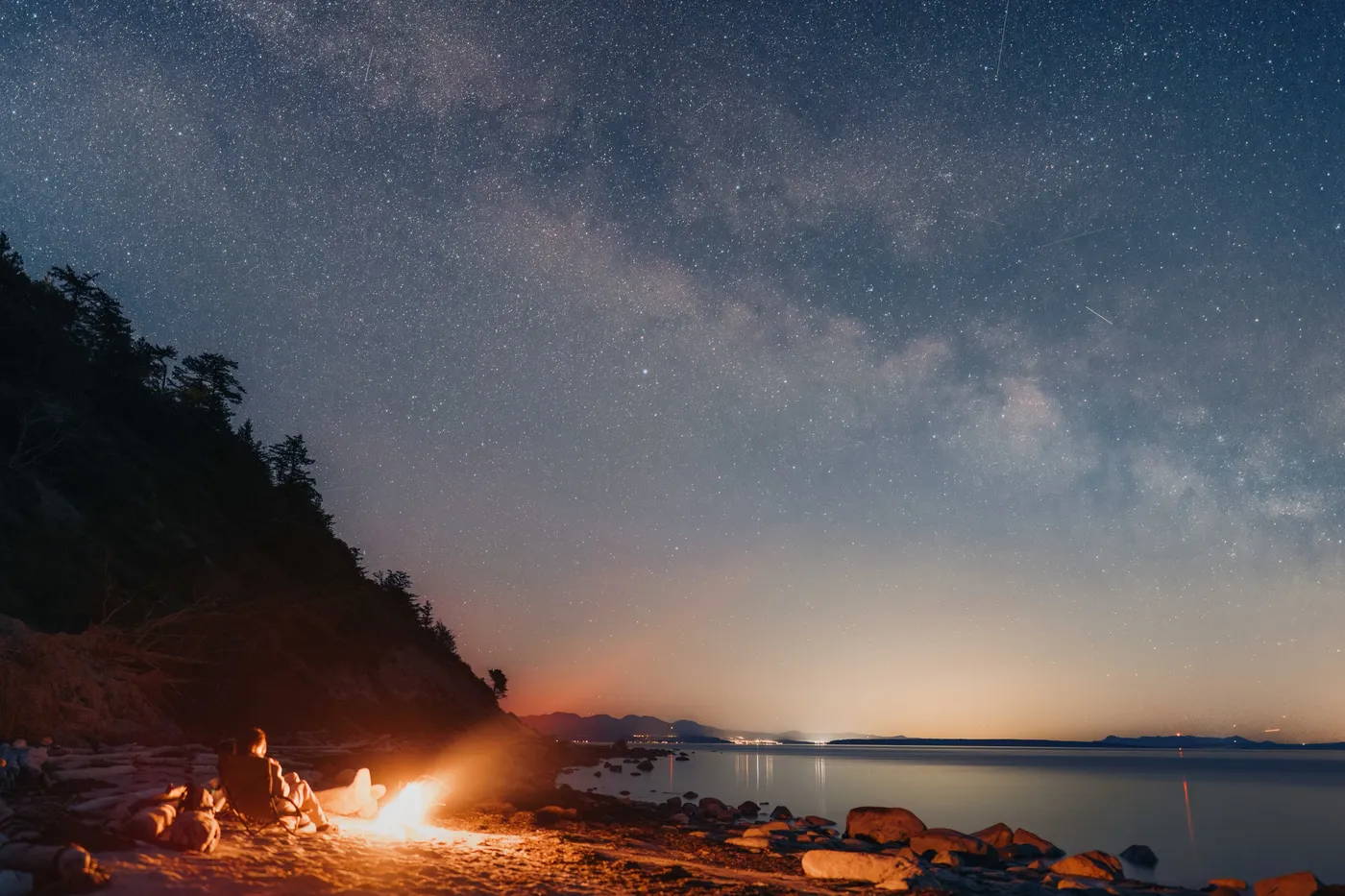
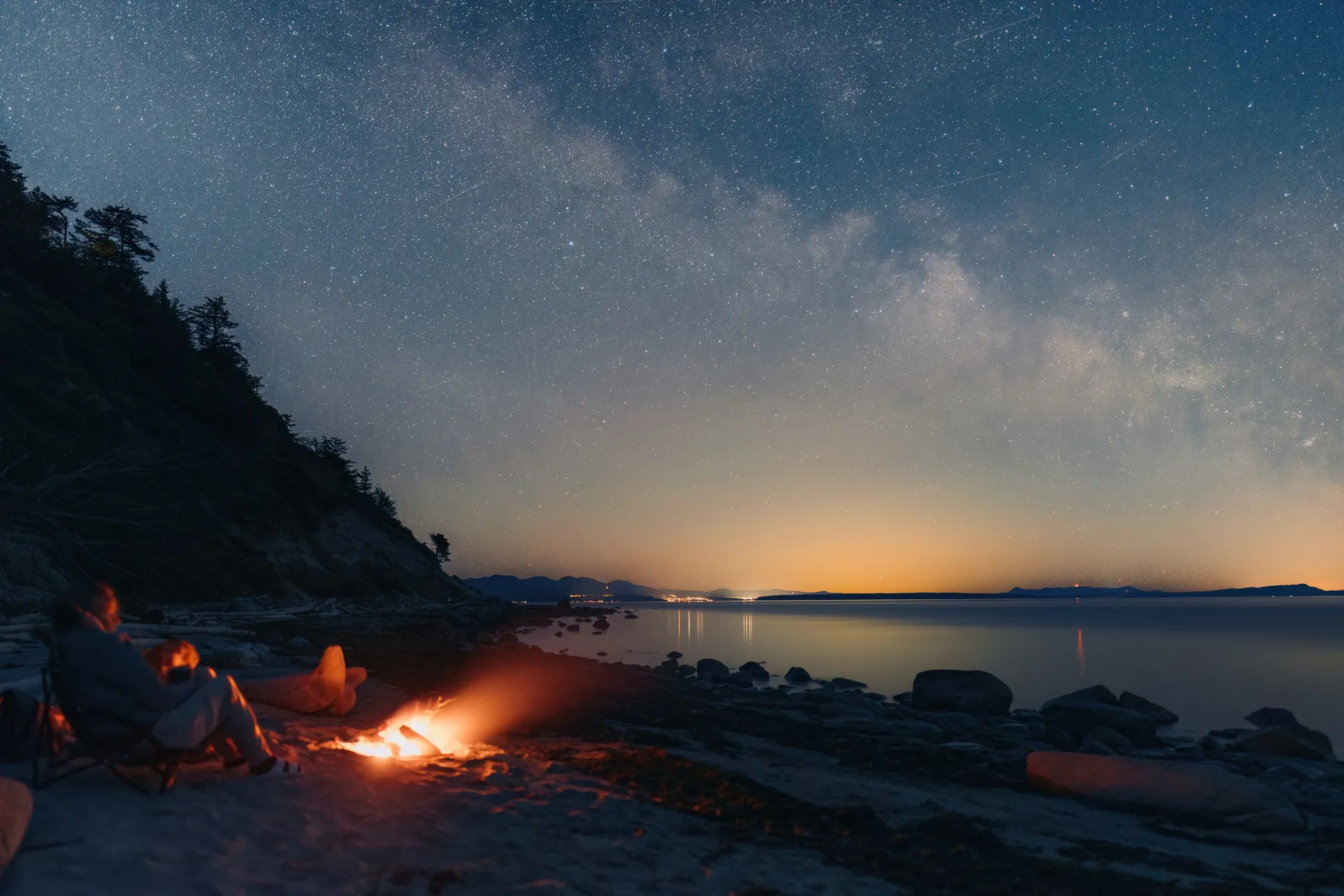
The south-facing beach gives a clean horizon for the galactic core to rise above — no trees, no hills, nothing interrupting the sight line.
The Campfire Shot: Why It Works So Well
The image I came away from Savary most satisfied with wasn't the cleanest Milky Way frame. It was the one with the campfire in it.
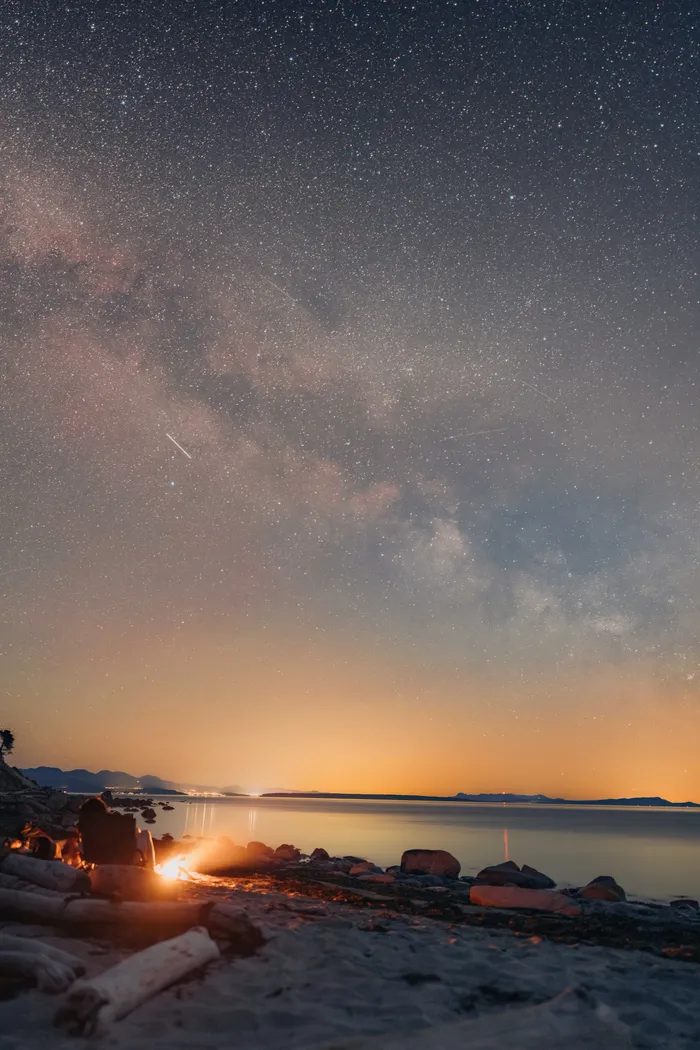
A campfire as foreground in an astrophotography composition does several things at once. The warm orange glow against the cold blue-white of the stars creates a colour contrast that makes both elements feel more intense. The fire implies human scale, which makes the Milky Way overhead feel genuinely vast rather than just a band of light in a photograph. The smoke and occasional ember trails add movement to what would otherwise be a static foreground.
Technically, a campfire is a challenging exposure element. The fire itself will blow out at any exposure that properly captures the sky. The choice is either to accept that overexposure and let the glow do its job, or to blend two exposures in post — one for the sky, one for the foreground. Either approach works. The blended version gives more control but takes longer. The single-exposure version has an immediacy that composites can sometimes lose.
Camera Settings: A Starting Point for BC Dark Skies
On a modern mirrorless camera from a dark location like Savary Island: start at ISO 2000 to 3200, f/1.8 to f/2.8 depending on your lens, 15 to 25 seconds. The 500 rule gives you a rough guide for avoiding star trails (500 divided by your focal length in mm = maximum exposure time), though the 400 rule is more conservative and worth using if you're printing large.
Wide lenses win for Milky Way photography. A 14mm to 20mm on a full-frame body captures the full arch of the galaxy in a single frame. Anything longer and you're cropping the composition significantly. The trade-off is distortion at the edges, which is worth managing in post rather than giving up the coverage.
Focus is where most beginners lose the shot. Autofocus doesn't work in near-darkness. The technique: switch to manual, use live view at maximum magnification on the brightest star visible, and fine-tune until the star is a point rather than a disc. Lock that focus and don't touch it again until the light changes.
Getting There and Planning the Shoot
Savary Island requires a water taxi from Lund or Powell River. The crossing is short but the logistics mean you're planning around tides and schedules in a way that a drive-to location doesn't require. Accommodation is limited — there's a small resort and camping options — which means booking well ahead for the June through August window when the Milky Way is highest.
Planning the shoot means stacking several variables at once: new moon or near-new moon phase, a clear weather forecast, and the Milky Way core visibility window from your latitude. June through August gives the best combination of all three, though July and August have the shortest darkness windows of the year.
Sitting on a remote BC beach at 2am with the Milky Way overhead and a campfire going low behind you is one of those experiences where the photography almost feels secondary. Almost.
What This Taught Me About Location Scouting for Astro
The best astrophotography locations are found in daylight. Walking the beach at Savary in the afternoon — noting where the southern horizon is clearest, where there's natural foreground interest, where the campfire would work compositionally — is what makes the midnight shoot efficient rather than exploratory.
Exploring a new location for the first time in complete darkness is frustrating and produces worse results than a site you've already walked in daylight. The difference between mediocre and exceptional astro photography is almost always pre-shoot location knowledge, not camera technique. The technique is learnable in an afternoon. The foreground is whatever the location gives you.
More astrophotography and night sky work from BC is in the Astro & Low Light portfolio. For aurora photography from Kelowna, read the Kelowna Northern Lights post. Prints of night sky images are available — get in touch to discuss.